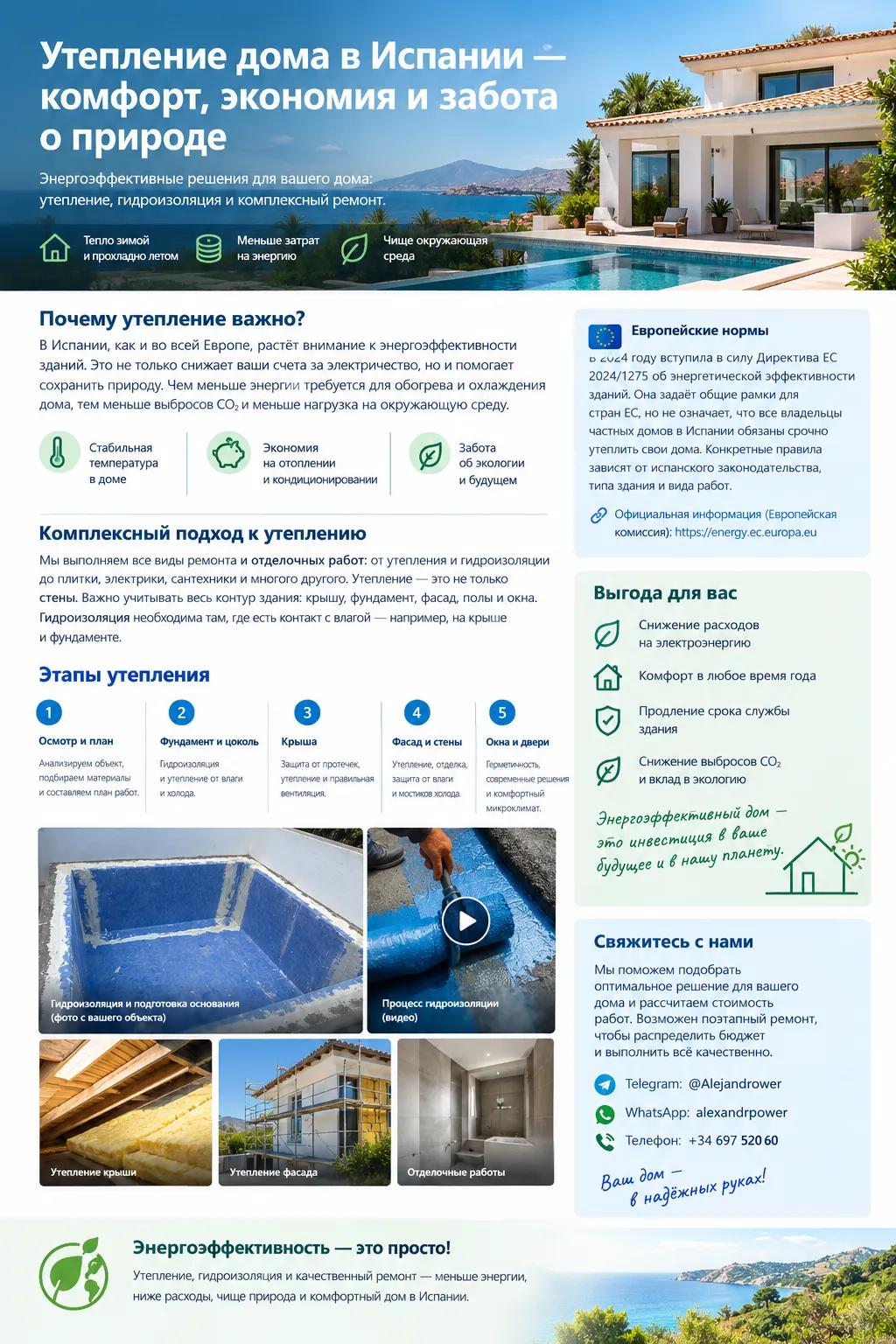
Insulating Homes in Spain: Savings, Comfort, and Care for the Environment
How to make a house cooler in summer, warmer in winter, and reduce electricity costs? Start with proper insulation!
In Spain, air conditioners run almost nonstop during the summer in many homes, and in winter additional heating is required. However, a significant portion of energy can be wasted if the roof, walls, and other building elements are not sufficiently protected from heat and cold.
Proper insulation helps maintain a comfortable temperature inside the house, reduce electricity consumption, and lower heating and cooling expenses.
There is also an ecological aspect: the less energy needed to maintain a comfortable temperature, the lower the emissions associated with its production—especially when the energy comes from fossil‑fuel sources.
European Energy Efficiency Requirements
The European Union is developing a program to improve building energy efficiency. An important document in this area is the EU Directive 2024/1275 on the energy performance of buildings.
At the same time, Spain does not have a single requirement that obliges all private‑home owners to complete full insulation by a common deadline. Specific requirements depend on the applicable building regulations, the type of building, and the nature of the work.
You can consult the official sources here:
• European Commission — Directive on the Energy Performance of Buildings.
• Spanish Technical Building Code (CTE), including energy‑saving requirements.
• IDAE — Practical guide to thermal insulation and energy renovation of buildings.
What Exactly Needs Insulating?
Effectiveness depends not only on the thickness of the insulation. It is important to consider the building’s condition, choose materials correctly, and follow proper installation techniques.
1. Roof. Helps reduce overheating of the house in summer and heat loss in winter. When needed, insulation is combined with roof repair and waterproofing.
2. Facade and exterior walls. Reduce heat transfer through walls. Depending on the building, suitable façade insulation systems, mineral wool, and other materials are used.
3. Foundation and plinth. Insulation helps limit heat transfer through these structures. If moisture is present, additional waterproofing measures are provided.
4. Floors, windows, and door joints. These areas also affect the overall result. It is essential to eliminate thermal bridges, properly treat joints, and ensure necessary ventilation.
Why Should Insulation and Waterproofing Be Planned Together?
Waterproofing is an important complement to insulation wherever the construction needs protection from water and moisture: for example, on the roof, foundation, or plinth.
If you cover a wet substrate with insulation or fail to fix leaks, you can create new problems instead of the expected result.
Therefore, first assess the condition of the structures, determine the cause of moisture, and select compatible materials. Only after preparing the substrate and fixing the necessary defects are the subsequent layers of the system applied.
Can a House Be Insulated in Stages?
Yes! It is not necessary to carry out all work at once. You can create a plan taking into account the building’s condition and the budget.
First stage — inspection and most essential work. Check the roof, foundation, and walls, identify leaks and damage. If needed, carry out repairs and waterproofing, then insulate the selected structures.
Second stage — completing the thermal envelope. Insulate the façade, necessary floor sections, treat window joints, and perform other tasks outlined in the plan.
The sequence depends on the object: if the roof is leaking, the leak is fixed first; if the structures are dry and sound, the priority can be set according to the expected effect of insulation.
We do more than just insulation
Our company performs repair and finishing work in buildings and structures. In addition to insulation and waterproofing, we handle tiling work, electrical work, plumbing, and other types of renovation.
This allows planning the work comprehensively: from preparing the base and moisture protection to insulation, surface restoration, and final finishing.
Our goal is not just to insulate a single area, but to select a practical solution for your home, taking into account the building’s structure, climate conditions, and your budget.
Planning insulation or a house renovation in Spain?
Contact us to discuss your project, choose suitable materials, and determine which tasks should be carried out first.
Telegram: @Alejandrower
WhatsApp: alexandrpower
Phone: +34 697 520 60
A comfortable home means lower unnecessary expenses, reduced energy consumption, and greater care for the environment.