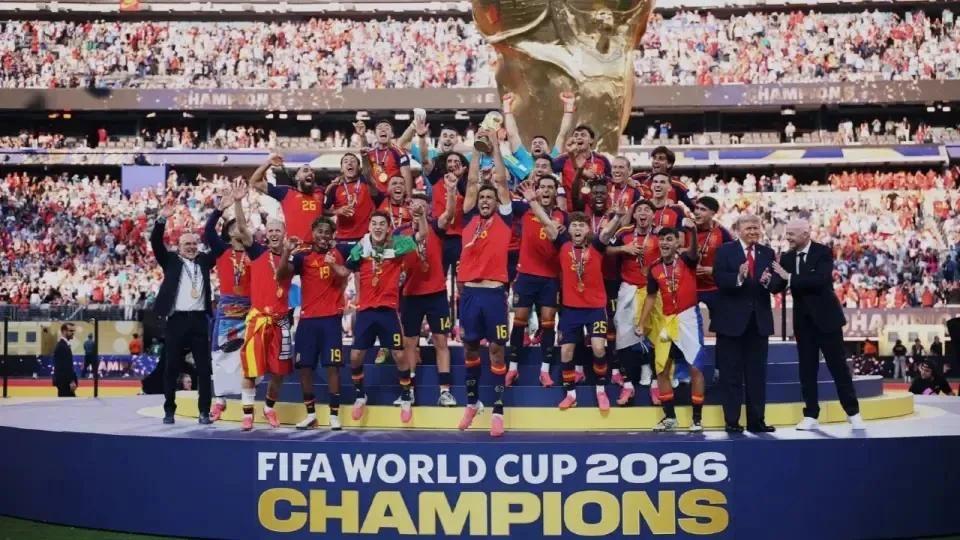
Invincible Armada: How Spain Rewrote History at the 2026 World Cup
July 19, 2026. Mexico City. The Estadio Azteca fell into a tense silence as Dani Olmo, captain of the Spanish national team, lifted the golden World Cup trophy above his head. For La Roja, this trophy was the second in history, but the first won under the leadership of a new generation that managed to step out of the shadow of the legends of 2010 and write its own chapter of greatness. Spain's path to the summit in the heart of Central America is a story of tactical flexibility, a focus on youth, and an absolute belief in its philosophy.
👉 Buy Weed / Marijuana / Cannabis Delivery Spain Torrevieja/ Alicante/ Benidorm /Valencia 👈
👉 Buy Weed / Marijuana / Cannabis Delivery Spain Torrevieja/ Alicante/ Benidorm /Valencia 👈
👉 Buy Weed / Marijuana / Cannabis Delivery Spain Torrevieja/ Alicante/ Benidorm /Valencia 👈
When the group stage draw sent Luis de la Fuente's charges into the "group of death" alongside Argentina and Japan, many skeptics predicted at least a tense battle for advancement for the Europeans. However, reality exceeded all expectations. In the opening match against the reigning world champions, the Spanish showed that their famous ball control was not an anachronism, but a weapon of retribution. Possessing the ball 73% of the time, they suffocated the attacking potential of Messi and company, securing a clean 2-0 victory with goals from Lamine Yamal and Nico Williams. That game was a declaration of intent: Spain came not just to participate, but to dominate.
Evolution of Tiki-Taka: From Possession to Aggression
The main tactical change that allowed the Spanish to triumphantly navigate the tournament was abandoning sterile possession for the sake of possession. De la Fuente, the architect of this team, built a system where verticality in attacks became a priority. Wingers Yamal and Williams, whose explosive speed terrorized defenders, stretched opposition defenses, creating corridors for disguised passes from Pedri and Olmo into the box.
This new, more predatory Spain showed itself especially brightly in the playoffs. In the dramatic quarterfinal against Brazil, when the Seleção equalized in the 89th minute and took the game into extra time, many expected a moral breakdown. But it was precisely at that moment that the character of the new generation emerged. Instead of giving up, the Spanish raised the tempo. The goal from substitute Fermín López in the 112th minute was not just the winner, but symbolic — this team can no longer be crushed psychologically; it has outgrown the traumas of past years when Spain was eliminated by Russia or lost on penalties.
The Final in Bronze and Gold: Redemption Against France
The final match at the iconic Estadio Azteca pitted Spain against France — the team that had beaten them in the Euro 2024 semifinal. This clash was immediately dubbed the "war of styles." The game turned out to be tight, nervous, completely devoid of the open football seen in the first halves of the group stage. Mbappé, who was tightly shut down by the young center-back duo of Cubarsí and Pau Torres, was cut off from the ball.
The key moment of the match came in the 67th minute. Rodri, named the tournament's best player, intercepted the ball in midfield and instantly launched a penetrating pass between the French center-backs. Lamine Yamal, who had celebrated his 19th birthday the day before, controlled the ball with the outside of his foot, shifted past a defender with a dummy, and fired into the top corner past Maignan. The goal, which became the highlight of the entire World Cup, set the final score at 1-0.
After the conceded goal, Spain once again demonstrated textbook game management. The last twenty minutes turned into a masterclass in holding a lead: short passes in the opponent's half, tactical fouls in midfield, and not a single truly dangerous attack on Unai Simón's goal. The French, whose bench was considered the strongest in the tournament, could not find the key to this defense.
Legacy and Records
The 2026 World Cup will go down in history not only for Spain's victory but also for a number of unique achievements. Lamine Yamal, who scored against France, became the youngest goalscorer in World Cup finals, breaking Pelé's record. The tournament itself, in a 48-team format, became the most representative in history, but it was the European side that managed to go the entire distance without a single defeat in regular time.
Spain's success is also a victory for the club system. Almost the entire core of the national team consists of graduates or current players of Barcelona and Athletic Bilbao. The Yamal-Pedri-Gavi connection, which had been forged in the fires of the Champions League, carried their chemistry to the international level, proving that betting on academies works without fail.
The triumph at the Azteca cemented Spain's status as a superpower of world football. By navigating a knockout path that included Argentina, Brazil, and France — three giants — La Roja silenced any arguments from those who spoke of "easy roads" to the final. This team didn't just win the cup. It brought romance back to the pragmatic world of modern football, proving that elegance and strength of spirit can defeat athleticism and cynicism. Spain is back on the throne, and this reign promises to be long.